
Shopping for jewelry in 2026 can feel like an exercise in pricing whiplash. If you’re searching online and in stores, you will see wildly different prices for seemingly similar pieces, and it can be hard to understand the variation. I thought I'd share what I’m observing in the market and how it relates to the prices you should expect to see here at Alx&Co., and I’m including something I usually don’t share: true-cost comparisons between us and major retailers. In a market seemingly obsessed with paying the least amount for the most “luxury,” I have some bad news: you’re not actually getting a good deal.
A “dupe” is almost never really an actual duplicate - it’s just a cheaper make
Just because something looks the same doesn’t mean it’s the same thing. Think about when you shop for a high-quality sweater. You’ll see very different price points for similar looks, but when you dig into the materials, you’ll notice important differences that will affect long-term wearability. With jewelry, there are meaningful differences between 14k gold-plated, gold vermeil, hollow gold, and solid gold, and, realistically, the only item that will truly last a lifetime will be made with solid construction (not plated or hollow).
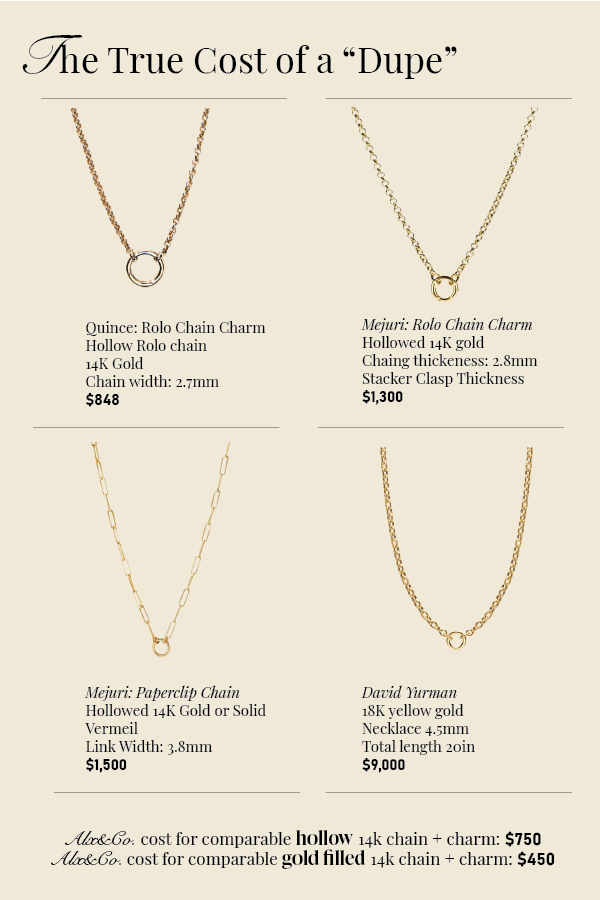
A quick search for a popular chain style highlights this perfectly. I dug into the materials & specifications of each style shown, and the first thing I noticed is that the Mejuri and Quince chains are 14k hollow gold. This is a material we don’t sell because our in-house workshop can’t repair it, and we don’t consider the make to be fine jewelry. Because I was curious, I went ahead and researched what it would cost us to source something comparable through our own vendors (note - the cost is not the sale price, it’s the amount we pay for the material). You’ll notice the math paints the difference between Mejuri and Quince pretty starkly in terms of their margins on each sale. And, note I said “margin,” not “profit,” because for a business, the cost of goods sold encompasses far more than just the material cost of the good itself. That margin needs to account for everything from product design and packaging to labor, guarantee coverages, and the many other expenses involved with running a business sustainably and making a profit. It’s hard to believe Quince is covering all of those points with a mere $100 margin on their chains and still adheres to “Responsible Sourcing and Labor Practices,” as their website states. I encourage you to do some quick research into the brand and decide for yourself. If we’re considering Mejuri, then you’ll want to consider that $1300-1500 is a lot of money to spend on something that can’t be repaired or restored (again - think about that sustainability pledge they make). Want to melt it for the gold value? At today’s prices, you could see about $250 from the estimated weight of the chain.
Materials only get you so far
Now, David Yurman’s $9000 chain? I realize it’s an eye-popper next to the Quince and Mejuri options, but it comes with equally eye-popping notes for you. All in, this is pretty close to what we would charge for a comparable chain, and our profit would be a fraction of what Mejuri is making on their hollow chains and a smaller fraction of what David Yurman is making on their mass-produced offerings (remember: scalability = higher profit margin).
18k gold is higher-quality content; it’s a solid make, and the guarantee comes with the convenience of in-person drop-off and local labor. Plus, anything we make comes with the option to customize it to your preferences. Look at the guarantees behind the pieces you are investing in. How easy will it be for you to resize the ring or repair a broken shank?
Of course, I realize that $9000 is an extravagant sum for many, many people, myself included. I am absolutely not telling you that you need to spend $9000 on your next jewelry purchase. But fine jewelry is supposed to be extravagant and especially right now, the cost of gold is extremely high so the baseline price of these goods is going to elevate as well. These goods should be expensive when you consider the material and business costs behind a local, service-based operation like ours. While we absolutely believe in offering pieces that can be worn and enjoyed every day, that doesn’t mean they should be everyday purchases.
Baseline: you get what you pay for
Private, bespoke services like what we offer at Alx&Co. almost always cost more than what you may find through an online-only store, a mass-market retailer, or even another mom-and-pop jeweler that offers customized (but not bespoke) services. Even our simplest designed pieces are created from scratch, so we don’t benefit from scaled production models that allow for more efficient pricing options for materials and casting.
But we can be more competitive with our pre-fabricated selections in our Ready-to-Wear section. There is no design process behind these, so you can benefit from better pricing as a consumer (albeit with fewer customization options). Still, our pricing may not always match major online retailers like Quince or Mejuri. We only sell jewelry we know will last and can be repaired by our team, so we don’t opt for air-light settings or tiny prongs just to bring down the cost of a piece.
In the end, we believe fine jewelry should be well made, durable, and crafted from solid, genuine materials so it can be restored and maintained for a lifetime. And we believe in investing in the talent and craftsmanship needed to do this work right here in our Old Town workshop.
